Best Trees to Use For Privacy Screen
An Informative Article by Yellow River Landscaping - Covington Georgia
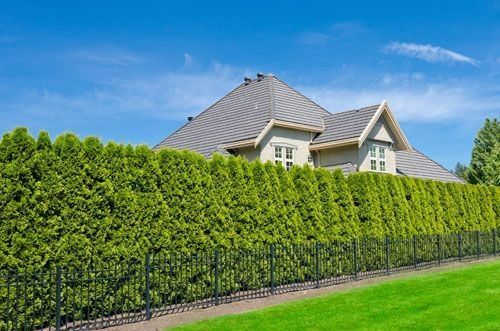
In neighborhoods or areas where homes are close together, it is very common to feel the need to create a border between homes. Fences don’t always do the trick, and can easily get very expensive, making trees the easiest way to create privacy in your yard. However this can also get difficult since the trees must be fast growing, with a wide diameter, and must cover from the ground up. There are many different options, and in this article we will give our professional explanation of each option, so you can determine which one is best for your yard.
The main three types of trees used in the United States are cypress, arborvitae, and cryptomeria. There are many variations within these three types of trees that are all used in different situations depending on the geographical area and what the needs are.
First, the cryptomeria. Cryptomeria has many different variations but the main two used for privacy screens are radicans, and yoshino. The two are very similar in shape and both are a very large tree with yoshino growing to heights near sixty feet with a thirty foot width, and radicans growing to fifty feet with a twenty foot width. Radicans tend to have a slightly richer color, and are better against disease than yoshino. One major benefit of the cryptomeria is that it allows a more dense screen, since they can grow together slightly better than the arborvitae or cypress. Typically, even when trying to create a screen, it is better to keep your trees further apart to keep them from getting diseased and choking one another out, and while this is still true for the cryptomeria, they are the best of the three at creating a thick connected wall to block out anything on the other side.
For the cypress, while there are also multiple varieties, there is one that stands out when wanting to create privacy. The leyland is the usually largest option at around seventy feet tall and twenty to twenty-five feet in diameter. They are fast growing and can easily cover larger areas in a short amount of time with a growth rate of three to five feet per year. The main issue with the leyland cypress is that it is disease prone. Due to its shallow root system, it is much easier for the leyland to die off than the arborvitae or cryptomeria, especially in the southeast and Covington Georgia area, where Yellow River Landscaping operates. The shallow root system causes the cypress to be less resilient during a drought, since they cannot pull moisture from deep in the soil. Planting the trees further apart (around 15 or more feet) can drastically improve the survival rate as contact between roots and limbs is a main source of getting and spreading disease, but leylands still do not typically survive longer than twenty years.
Lastly the Arborvitae which has two main varieties, the green giant and the emerald green. These two varieties are actually vastly different in both size and appearance. The green giant, as the name suggests, is the larger variation growing to around 50 feet tall and twenty feet in diameter. The emerald green is the smallest variety tree that is commonly used for privacy, with a height of twenty feet and a width of five to six feet. The main difference other than height in these two types of arborvitae is that the emerald green has a deeper and richer color, as well as more dense growth and tighter shape. Green giants tend to have more gaps as well while the smaller emerald green stays full and retains more of a christmas tree or pencil shape. The main benefits of the arborvitae are that they are one of the fastest growing types of tree, as well as having great resistance to disease (particularly here in Georgia). The green giant grows around three to four feet per year, while the emerald green grows about one foot per year, which is still impressive for its mature size. It is recommended that you plant green giants at least ten feet apart if they are going to be in a straight line, and two to three feet for emerald greens.
When choosing a tree to use as a privacy screen make sure to also check which diseases are common to your area and check your growing zones. To know how far apart to plant these trees, it should usually be at least half the width, to best avoid disease. However, to create a more dense screen and keep your trees healthy, consider planting them in a checkerboard pattern to fill all gaps without leaving the trees too close together to damage them. To get any more information on these trees and what is best for your area, call or visit your local nursery, otherwise, for any more questions just call Yellow River Landscaping LLC at 678-5, servicing all of Covington and the surrounding area.
For more tips or contact information, visit
yellowriverlandscaping.com